


faster
Ready to serve MegaWatt
Charging capabilities

Lighter
Up to 65% weight
reduction

More value
Up to 70% material
reduction

adaptable
Personalized to
customer habits
High-Performance Charging Architecture for Megawatt Applications and beyond
Reducing charging time remains a key technical challenge in EV architectures. Increasing current levels inevitably leads to higher thermal loads – particularly within the vehicle-side charging harness and socket interface.
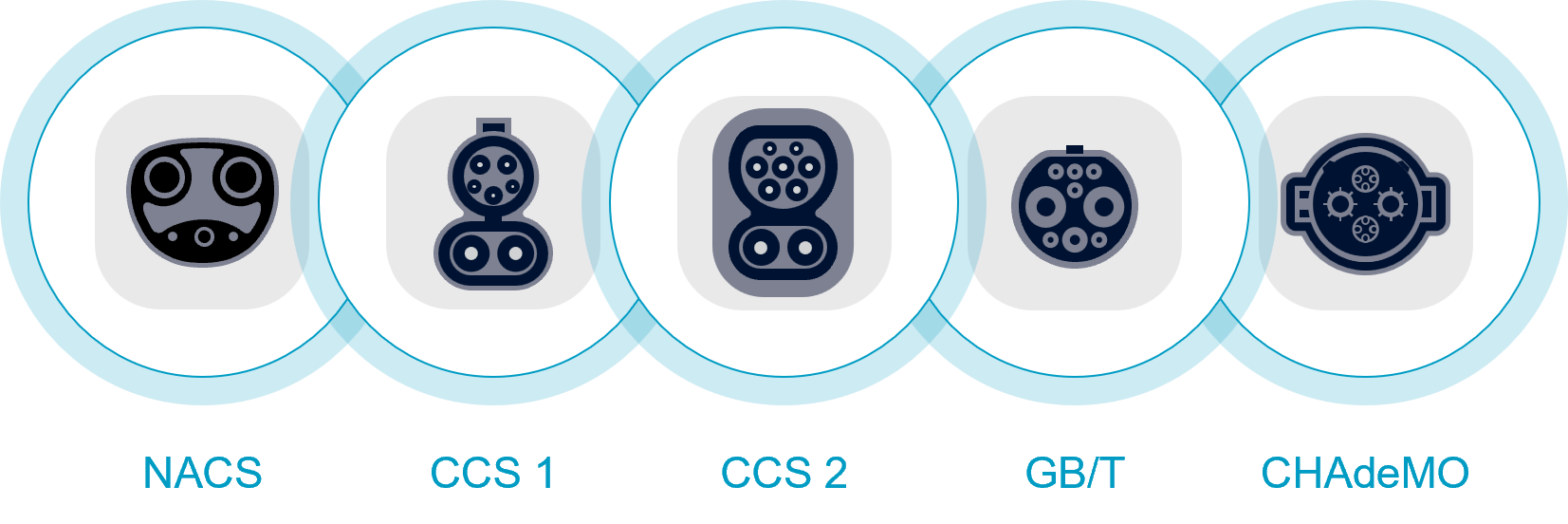
GG Group, VOSS Automotive and Amphenol-Tuchel Electronics have jointly developed a cooled high-voltage charging harness with a functional CCS2 solution already available. All regional interface standards such as NACS, CCS1, GB/T and CHAdeMO are supported. By integrating cable design, connector technology and fluid-based thermal management into a coordinated system, current capacity can be increased by up to 70% compared to conventional non-cooled solutions.
The architecture is engineered for next-generation high-power charging platforms.



Director Group Product Management & Business Development
Interested in Power2Flow? Let’s talk.
Download the White Paper now
Learn more about the technology behind Power2Flow®. The white paper covers the system architecture, validation results, and efficiency findings for future megawatt charging applications.

THE CHALLENGE:
Thermal constraints limit charging performance.
While inverters, e-motors and HV batteries are liquid-cooled, the electrical interconnects and vehicle-side charging cables are typically not. As a result, charging currents must be regulated to prevent overheating – limiting achievable charging performance.
Conventional approaches compensate by increasing conductor cross-sections or implementing rigid busbars. This leads to higher system weight, reduced flexibility and integration challenges within constrained packaging spaces.
A scalable solution requires thermal management directly within the
charging path.


Thermal Stress in the High-Voltage System is a Limitation
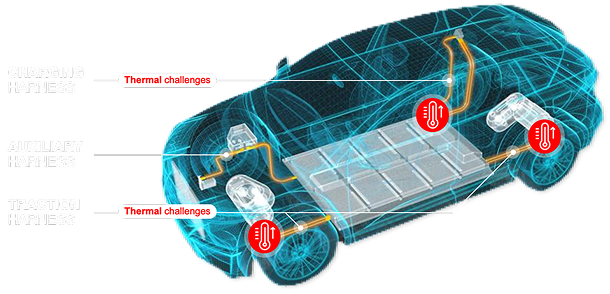
How we tackle the challenges

Cooled harness systems as the missing link between high power distribution requirements
Flexible and light weight harness for high power transfer
Strategic partnership with interconnection system suppliers for liquids and electrical energy
A scalable and adaptable solution to reduce variants
Highest ampacity at reduced weight
THE SOLUTION:
Active cooling integrated into cable
and socket.
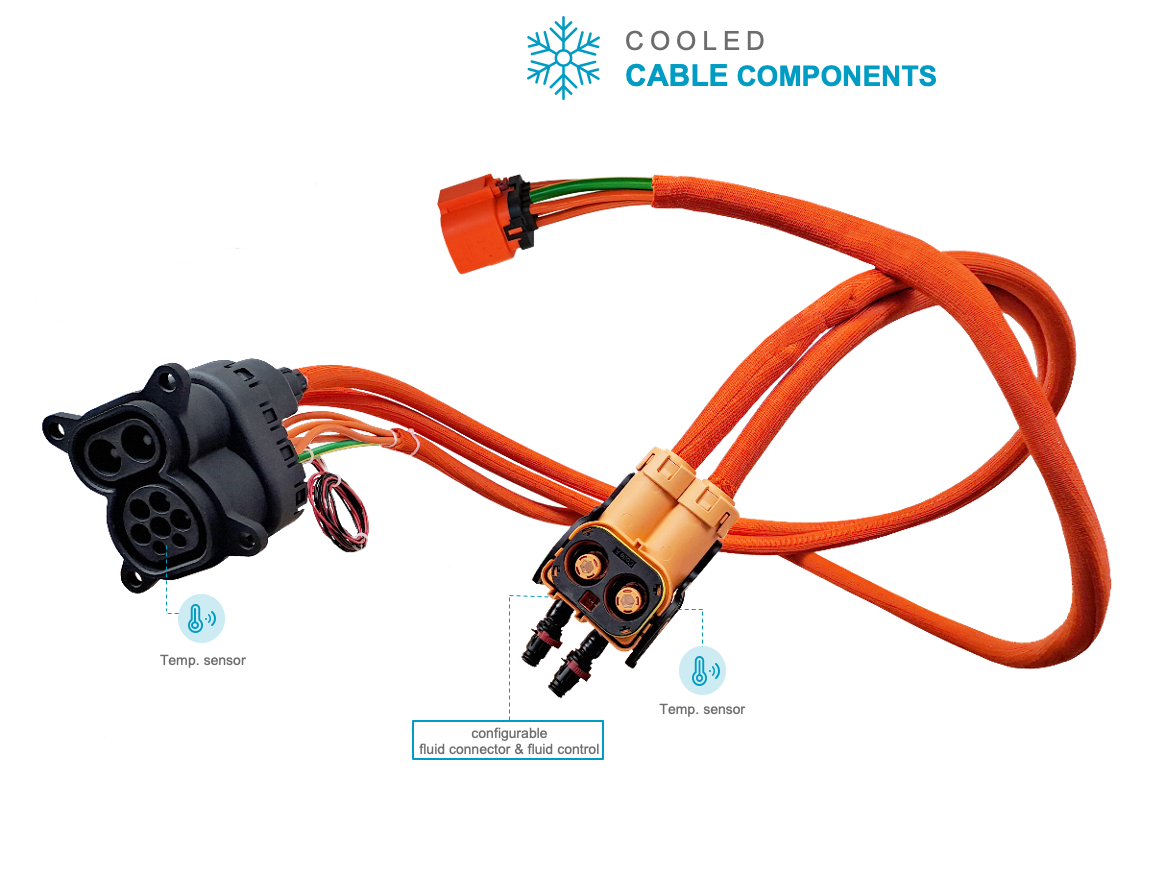
The Power2Flow® high-voltage charging harness integrates a VOSS multi-layer polymer heat exchanger directly within the cable structure. The system transports coolant from the battery interface to the charging inlet — targeting the area of highest thermal load.
The design enables efficient heat dissipation while maintaining electrical insulation and compatibility with water-glycol mixtures as well as immersion fluids. Improved thermal conductivity allows a reduction in conductor cross-section without compromising current-carrying capability.
The system interfaces with the performance-optimized CCS2 charging socket CHARGESOK®, featuring direct cooling of the DC contact chambers. Active cooling at the point of current transfer significantly improves thermal stability under high-load conditions.
The result is a fully coordinated electro-thermal charging architecture.
Existing CCS2 Harness Prototype

Light weight: Weight reduction

Flexibility: Improved handling

Temperature: Power2Flow® cooled cable

Material: Aluminum
Supported regional interface standards
THE VISION:
Charging in Less Than 5 Minutes
By enabling consistently higher current levels throughout the charging cycle, the cooled HV charging harness supports substantial reductions in charging time — with the long-term objective of sub-5-minute charging scenarios, depending on battery system capability.
Low weight, high flexibility and media adaptability facilitate integration into diverse vehicle platforms and cooling architectures. The system is designed for scalability across future high-power charging environments.
A technology platform supporting the next generation of high-performance EV charging systems.


Closing
the Heat Gap.
