Authors: Kristen Mogensen (Texas Instruments), Carlo Salata (Canvatech), Thomas Keller (Rosenberger), Uwe Günther (Renesas), Simon Huber (Rosenberger), Alexander Mozgovenko (CAST), Marco Chen (Murata Electronics), Stefan Gianordoli (GG Group), Dr. Ales Markytan, Dr. Dieter Gross (Murata Electronics / EBV Elektronik), Tianhai Yang (Zhaolong), Ulrich Graf, Jie Le (Weidmüller Group).
The full white paper of the Single Pair Ethernet Alliance, "Single Pair Ethernet (SPE) for Humanoid In-Robot Network", is also available for download here
Content
- Introduction
- Evolution of robotics
- Specific challenges and requirements for humanoids
- Humanoid In-Robot Network and the case for SPE
- Summary
Introduction
Market forecast
Amid the growing hype, an influx of new players and startups, and strong venture capital funding, the market is widely viewed from both optimistic and realistic perspectives as a large opportunity by 2030. While Goldman Sachs Research forecasts a global market size of USD 38 billion by 2035, likely too optimistic, other outlooks such as the Interact Analysis forecast suggest a more balanced view.
Market drivers
LLMs (Large Language Models), LBMs (Large Behavior Models), VLAs (Vision Language Action Models), Agentic and Embodied AI, demographic development and ageing societies, labour shortages, repetitive or dangerous work automation, and decreasing costs combined with a fast ROI are the main drivers.
Evolution of robotics
Historic development
The development of robotics has progressed from industrial robots to cobots, AMRs (autonomous mobile robots), AGVs (automated guided vehicles), service robotics and ultimately to humanoids.
Why humanoids?
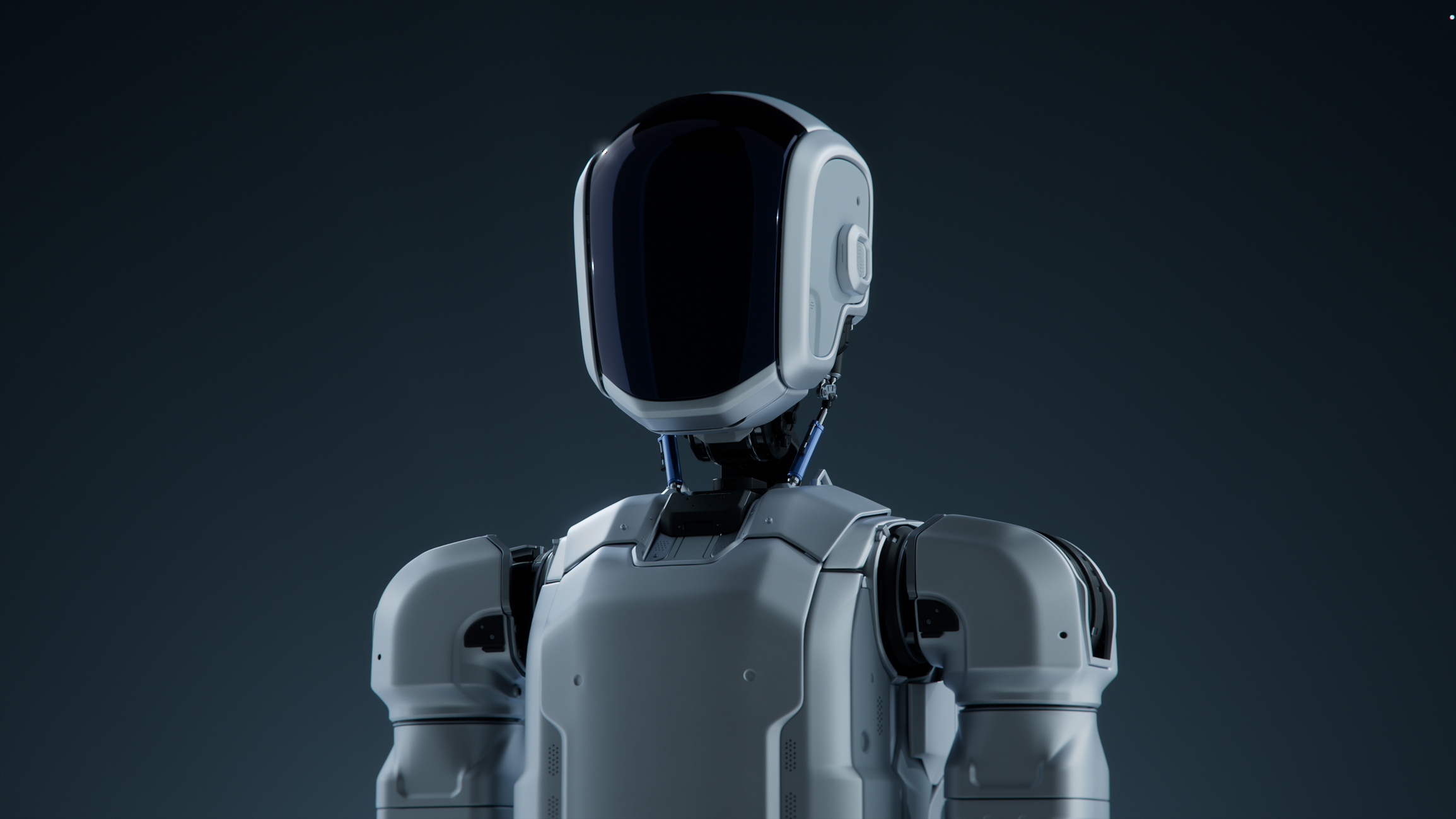
Humanoids are intended as a type of mechanical twin for humans. A key benefit is their ability to learn by observing and recording human labour and activities. As a result, they are intelligent and cognitive, operate in environments designed for people, understand text and language including voice commands, and can perform multiple tasks while handling tools.
Typical use cases include:
- High-mix, low-volume manufacturing
- Repair and maintenance tasks
- Over-the-air proprietary skill updates
- Residential and home environments
Humanoids need a new approach
Humanoids differ significantly from previous robot categories and therefore require a fundamentally new design approach.
Comparison of industrial and humanoid robots
| Criterion | Industrial Robot (Arm) | Humanoid Robot |
|---|---|---|
| Market Players | Established for decades | New companies and start-ups |
| Market Dynamics | Low, slow | High, very fast |
| Axis / Degrees of Freedom | Typically 6 + gripper/tool | Up to 72+ |
| High-Level Control | PLC with kinematic motion model | AI robotic computer with humanoid foundation model |
| Low-Level Control Protocols | PROFINET®, EtherCAT®, EtherNet/IP®, POWERLINK, Sercos III, CC-Link | CAN/CAN FD, EtherCAT®, PROFINET®, EtherNet/IP®, TSN |
| Sensors | Joint positions and robot state | Encoders, force/torque, cameras, radar, lidar, ultrasonic, tactile sensors, IMU, microphones |
| Human-Robot Interaction | No interaction, protected area | Direct collaboration with humans and machines |
| Flexibility | Single programmed task | Reinforcement learning, Sim2Real, tool usage |
| Costs | High | High but decreasing rapidly |
| Functional Safety | Defined | Not fully defined, adapting concepts from cobots |
| System Architecture | Open and closed systems | Mostly closed systems |
Specific challenges and requirements for humanoids
Lightweight and Powerful
Humanoids must balance mass and mechanical output while achieving a high weight-to-peak-performance ratio. The ability to carry payloads exceeding 25 kg while maintaining agility and durability is a hallmark of advanced humanoid robotics.
Electric motors and gear systems used in robotic joints require torques of up to 300 Nm. To minimise inertial loads without sacrificing structural integrity, manufacturers increasingly rely on lightweight materials such as magnesium alloys and carbon fibre composites.
Recent demonstrations, including robots performing front and back flips, have highlighted significant progress in actuation and real-time control algorithms. Events such as the Humanoid Robot Half-Marathon in Beijing (April 2025) challenge endurance, agility and payload capacity. The first World Humanoid Robot Games (August 2025) further demonstrated advances in locomotion and manipulation skills.
These public demonstrations validate hardware designs while also requiring robust failure handling and repeated operation under stress, both of which are vital for industrial and service applications.
Thermal Management in Dense Mechatronic Systems
High-torque actuators, compact joint modules and power-dense AI compute boards generate significant thermal loads within the confined volume of a humanoid body.
Without a dedicated thermal management strategy, heat accumulation reduces actuator efficiency, shortens electronic component lifetime and can trigger derating or emergency shutdowns that interrupt mission-critical tasks.
Modern humanoid systems therefore incorporate:
- Aluminium housings
- Internal heat spreaders
- Compact DC fans
- Directed airflow channels
These are particularly important in thermally critical areas such as:
- Torso
- Thighs
- Head
Industrial operation requires clearly defined limits for:
- Maximum junction temperatures
- Allowable temperature rise during peak loads
- Coordination of thermal sensors and control software
Thermal constraints also influence:
- Component placement
- Limb cross-sections
- Actuator selection
- Ventilation concepts
- Enclosure design
- Acoustic noise behaviour
Battery Technology
Battery technology is fundamental to operational flexibility and endurance.
Several hours of operation on a single charge have become a baseline requirement. This drives the adoption of high-density lithium-ion batteries and, in the future, solid-state batteries.
Automated charging stations combined with hot-swappable battery modules enable near-continuous operation in applications such as:
- Logistics
- Manufacturing
- Healthcare
Battery management systems (BMS) coordinate:
- Energy load management
- Thermal control
- Predictive maintenance
Advances in rapid charging further reduce downtime. Novel cell designs, including semi-flexible and ultra-slim formats, are currently being explored for next-generation humanoids.
As robots become increasingly autonomous and capable of completing extended missions, battery design and overall system architecture must be tightly integrated.
Wheeled or Bipedal Locomotion?
Wheels excel in predictable environments such as warehouses and factories, offering speed, efficiency and simplified navigation on flat surfaces. Bipedal and multi-legged systems consume more energy and are mechanically more complex, but they can handle stairs, uneven terrain and obstacles commonly found in human environments.
Hybrid platforms such as Hexagon's AEON combine wheels and legs, allowing them to switch mobility modes depending on terrain and task requirements. The choice between wheeled and legged locomotion ultimately depends on the application, and both approaches are expected to coexist across commercial and research use cases.
High Performance AI Computer, Low Energy Consumption
At the heart of a humanoid robot is a computing platform capable of running sophisticated AI models in real time while maintaining low energy consumption.
Important metrics include:
- TOPS (Tera Operations per Second)
- TOPS per watt
- Available system memory
- Storage capacity for foundation models
Platforms such as NVIDIA Jetson Orin and the upcoming Jetson Thor are becoming common within the ecosystem.
Large Behaviour Models (LBMs), Vision Language Action Models (VLAMs) such as NVIDIA GR00T and Google Gemini Robotics, and specialised architectures such as Figure AI Helix combine perception and action into integrated systems.
These technologies support:
- Reinforcement learning
- Imitation learning
- Teleoperation
- Sim2Real approaches
This requires fast local processing, reliable data storage and the ability to optimise behaviour within the energy constraints of an onboard battery.
Functional Safety, Safe and Efficient Operation
Functional safety places important constraints on the overall system design. Humanoid robots must operate efficiently while inherently protecting people and their environment.
Cloud and edge architectures increasingly support fleet coordination and centralised management.
Positioning and proximity detection can be achieved through:
- Inside-out tracking performed by the robot itself
- Outside-in tracking using environmental sensors or beacons
Emergency stop systems must immediately place a robot into a safe and stable condition, independent of its current motion.
Safety strategies include:
- Real-time reaction to sensor failures
- Predictive fault monitoring
- Safe fallback states
For direct human-robot collaboration, relevant international standards such as ISO 10218 and ISO/WD 25785-1 must be considered.
Large Number of Sensors
Humanoid robots require a large number of distributed sensors and sensor arrays to accurately perceive both their own state and their environment.
Typical sensors include:
- Joint encoders
- Force and torque sensors
- Multi-spectral cameras
- Distance sensors
- Tactile arrays
- Accelerometers and IMUs
- Microphones
The resulting heterogeneous data streams must be captured and fused in real time.
Centralised architectures using high-performance FPGAs and custom ASICs often process data rates reaching multiple gigabytes per second.
Sensor fusion algorithms must:
- Minimise latency
- Maximise reliability
- Improve environmental understanding
Advanced tactile sensing and lidar-camera fusion continue to expand manipulation and exploration capabilities.
Large Number of Actuators
A humanoid robot typically integrates between 50 and 80 rotary and linear actuators.
Joint modules are becoming increasingly:
- Integrated
- Modular
- Space-optimised
Hierarchical control architectures allow deterministic real-time actuation of every degree of freedom, improving both speed and precision.
At the same time, engineers must minimise:
- Vibrations
- Acoustic noise
- Mechanical interaction between simultaneously operating joints
Deterministic communication networks and closed-loop control systems ensure that commands are translated precisely into motion while continuously correcting errors.
Cabling and Connector Requirements
I/O connectivity and internal wiring represent major engineering challenges in humanoid robots.
As the number of sensors and actuators increases, so does the demand for power, data and communication cabling, despite strict constraints on installation space and overall weight.
Ethernet-based control systems support:
- Deterministic communication
- Robust fault handling
- Integration of heterogeneous subsystems
Mechanical Requirements
- Millions of bending cycles in robotic joints
- Torsion resistance for rotating joints such as wrists and necks
- Small bending radii within restricted installation space
- Integrated strain relief to protect contacts
Electrical Requirements
- EMC-shielded cables against motor and switching-electronics interference
- High-speed, low-latency data transmission for sensor and vision systems
- Efficient and reliable power transmission under environmental influences
Environmental Requirements
- Resistance to vibration and temperature cycling
- Abrasion resistance inside moving joints
- Chemical resistance
Design Requirements
- Compact dimensions for restricted installation spaces
- Hybrid solutions combining power and data within a single connector or cable
Dexterous Hand Manipulation
Despite tremendous progress in locomotion, dexterous hand manipulation remains one of the most challenging fields in humanoid robotics.
Highly articulated robotic hands such as the Shadow Robot 24-DoF hand provide exceptional dexterity, but introduce significant mechanical, sensing and control complexity.
Tactile sensors integrated into fingertips provide critical feedback for:
- Grasp stability
- Object recognition
- Force control
The mean time between failures for these sophisticated hands often remains below 100 operating hours.
Modular servo-electric hands, such as those developed by Schunk, improve serviceability and adaptability. However, long-term durability and seamless control integration remain active areas of development and research.
Summary
Humanoid robots place unique demands on internal communication systems. Large amounts of sensor data must be processed, powerful actuators must be controlled and real-time AI workloads must be executed simultaneously.
At the same time, weight and installation space must be minimized while reliability must be maximized.
Inspired by zonal vehicle architectures and their reduced node complexity, Single Pair Ethernet provides a lightweight, scalable and deterministic backbone for internal robot networks.
Combined with Time-Sensitive Networking (TSN) and the potential of Power over Data Line (PoDL), SPE supports high-performance sensor-actuator control loops while reducing cabling complexity.
Established real-time industrial protocols such as EtherCAT®, PROFINET® and EtherNet/IP® are fundamentally well suited for these applications and already provide mechanisms supporting functional safety.
However, protocol vendors must address the application-specific requirements of humanoid robots, support SPE as a physical layer and enable communication within closed industrial systems.
As humanoid robots mature and move toward widespread adoption, SPE has the potential to become the fundamental “nervous system” of future software-defined robotic platforms by balancing size, performance and functionality.
The Technology of the Future
Advancing Together
The Single Pair Ethernet System Alliance is an open consortium of leading technology companies and scientific organizations from a wide range of industries and application areas.
Manufacturers of sensors, cables, connectors, measurement equipment, semiconductors, switches and end devices work together to establish SPE solutions across a broad spectrum of industrial and commercial applications.
The alliance promotes:
- Interoperability across vendors
- Standardized technologies and interfaces
- Knowledge sharing within the SPE ecosystem
- Accelerated adoption of SPE in new markets
By combining expertise from different disciplines, the alliance helps create scalable and future-ready SPE solutions for emerging technologies including humanoid robotics.
Become a Member
Single Pair Ethernet System Alliance e.V.
De-Saint-Exupéry-Strasse 10
60549 Frankfurt am Main
Germany
info@singlepairethernet.com
05/2026
Technology of the Future
Single Pair Ethernet combines lightweight cabling, deterministic communication, scalable networking and support for modern Ethernet ecosystems in a single technology platform.
As humanoid robots continue to evolve, their internal networks will require higher bandwidth, precise synchronization, reduced weight and increased reliability. SPE directly addresses these requirements by delivering a compact communication infrastructure that supports sensors, actuators, AI computing platforms and future software-defined robotic architectures.
With its ability to transmit data and power over a single twisted pair while supporting industrial real-time communication technologies, SPE is positioned to become a key enabling technology for the next generation of humanoid robots.